How to Get Back Into Running Without Burning Out

If you’ve ever tried to get back into running and thought, this time will be different, only to find yourself exhausted, frustrated, or quietly quitting a few weeks later, you’re not alone.
Coming back to running after time off can feel surprisingly vulnerable. You remember what you used to be able to do. You remember the rhythm. The confidence. And even when you tell yourself you’ll take it slow, there’s a nagging pressure to “get back” quickly.
This isn’t a guide to pushing through. It’s a realistic reset for returning to running without repeating the same burnout cycle again.
Why Most People Burn Out When They Return to Running
Burnout usually doesn’t happen because someone doesn’t love running enough. It happens because they try to restart from memory instead of reality.
A few common traps show up again and again:
Starting where you were, not where you are
Treating motivation like something permanent instead of something that ebbs and flows
Adding structure, volume, and expectations all at once
I’ve fallen into all of these myself.
Once, I returned to running after ten weeks off with a hip injury. My last run before stopping had been a half marathon PR. On paper, I was fitter than I’d ever been. In reality, my body had spent over two months healing. I was deeply humbled by what my body could actually handle (spoiler: it wasn’t the same paces as before).
Another time, I came back after anemia took me out for nearly two months. My final run before stopping was a 28 km long run. Again, strong ending. Long pause. Completely different starting point.
In both cases, the temptation was the same. You know how to do this.
That mindset is exactly what leads people to burn out again.
What “Starting Slow” with Running Actually Means (Not What Instagram Says)
Starting slow does not mean reluctantly jogging for a week and then ramping everything back up immediately. As the saying goes: great things take time.
For me, starting slow meant something that almost felt absurd at first.
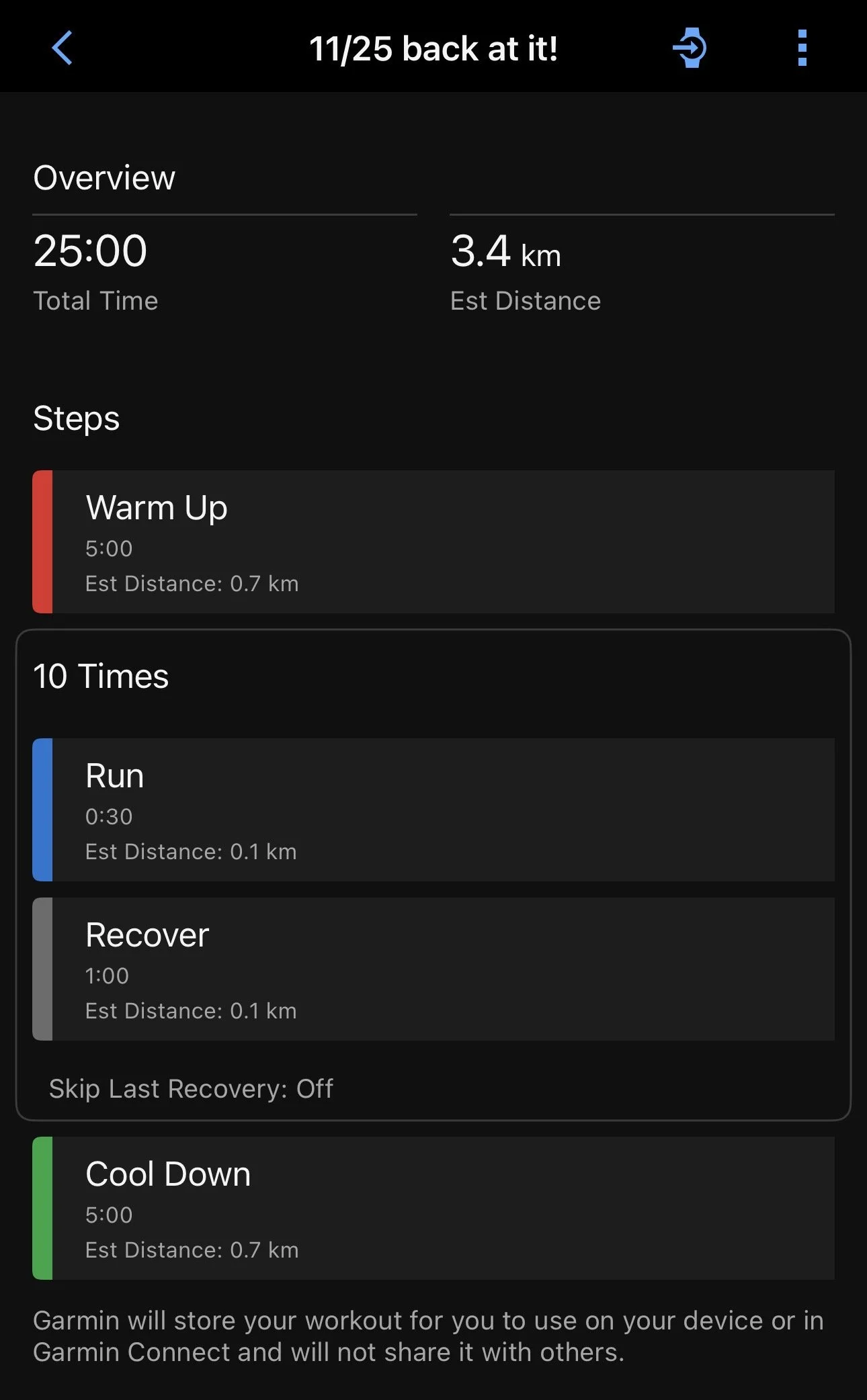
I resumed running with very gradual run/walk intervals sandwiched between a walking warm-up and walking cool-down. Short enough that I genuinely wondered if it counted. There were days it felt like I was barely doing anything at all.
But I made one decision that changed everything. I prioritized time on my feet, not pace, not distance, and not proving anything.
Starting slow looked like:
short, repeatable sessions
walking breaks without guilt
stopping before I felt depleted
It wasn’t flashy. It wasn’t impressive. But it was sustainable.
A Realistic 3 to 4 Week Reset Without a Rigid Plan
If you’re getting back into running after a break, burnout, illness, or injury, you don’t need a perfect plan. You need a flexible container.
Here’s what a realistic reset can look like:
Frequency: 2 to 3 runs per week
Duration: 20 to 30 minutes total per session
Structure: walk or very light jog warm up and cooldown, run-walk intervals if needed (which in most cases, likely are needed)
Goal: finish feeling like you could do it again tomorrow
This is where a lot of people go wrong. They wait for runs to feel “worthy” before trusting the process. In reality, boring consistency is what rebuilds resilience.
Those early runs that feel underwhelming are often doing the most important work.
A Treadmill or Pre-Programmed Intervals Can Help
When you’re getting back into running, removing decision-making from the run itself can be surprisingly helpful.
If you have access to one, a treadmill can be a safe re-entry point because the pace is set for you. There’s less temptation to speed up when you feel good for a few minutes, and less mental energy spent checking pace or distance.
The same goes for programming run/walk intervals into your watch or wearable. When the intervals are set in advance, you don’t have to constantly look at your watch or negotiate with yourself mid-run. You just follow the cues and focus on how your body feels.
When I returned after both injury and anemia, this helped me stay honest with how gradual the reset needed to be. It wasn’t about holding myself back. It was about protecting the long game.
What to Do When You Miss Runs So You Don’t Spiral
Missing runs is part of returning to running. The spiral comes from what we tell ourselves afterward.
The fastest way back to burnout is trying to “make up” missed sessions. Doubling up. Adding mileage. Forcing momentum.
Instead, treat missed runs as neutral information. Nothing to fix. Focus on the next run, and don’t try to compensate. Progress isn’t built by perfect streaks. It’s built by returning again and again without punishment.
How to Tell the Difference Between Discomfort and Burnout
Some discomfort is normal when returning to running. Burnout is something else entirely.
Discomfort looks like:
mild soreness that fades
nerves before a run that settle once you start
feeling rusty but curious
Burnout shows up as:
dread that builds day after day
exhaustion that sleep doesn’t fix
resentment toward running itself
When I returned after both injury and anemia, I paid close attention to how I felt after runs, not just during them. Did I feel calmer or more depleted? More grounded or more anxious?
That question mattered more than any pace or distance.
The Goal Isn’t Momentum. It’s Trust.
When you’re getting back into running, momentum can feel seductive. It feels like proof. Like safety.
But momentum fades. Trust is what lasts.
Trust that you can start again without rushing.
Trust that slow progress still counts.
Trust that running will still be there if (and really…when) life interrupts.
Every time I’ve returned to running after time off, what mattered most wasn’t how quickly I rebuilt fitness. It was whether I rebuilt trust in myself.
That’s what keeps you running long after initial motivation wears off.
